Thursday, 22 May 2014

31 killed, 90-plus injured in Xinjiang attack


BEIJING — Thirty-one people were killed and more than 90 injured in an attack Thursday on a busy street market in the capital of China's volatile northwestern region of Xinjiang, the local government said, the bloodiest in a series of violent incidents blamed on radical separatist Muslims.

The Xinjiang regional government said in a statement that the early morning attack in the city of Urumqi was "a serious violent terrorist incident of a particularly vile nature."


The assailants crashed through metal barriers in a pair of SUVs at 7:50 a.m. and plowed through crowds of shoppers while setting off explosives, the statement said.
The vehicles then crashed head-on and one of them exploded, the official Xinhua News Agency reported. It quoted an eyewitness as saying there were up to a dozen blasts in all.
It was not immediately clear who was responsible for the attack, but recent violence in the region has been blamed on extremists from Xinjiang's native Turkic Uighur Muslim ethnic group seeking to overthrow Chinese rule in the region.
The death toll was the highest for a violent incident in Xinjiang since days-long riots in Urumqi in 2009 between Uighurs (pronounced WEE'-gurs) and China's majority Han left almost 200 people dead. Thursday's attack also was the bloodiest single act of violence in Xinjiang in recent history.
"I heard four or five explosions. I was very scared. I saw three or four people lying on the ground," said Fang Shaoying, the owner of a small supermarket located near the scene of the blast.
Photos from the scene posted to popular Chinese social media site Weibo showed at least three people lying in a street with a large fire in the distance giving off huge plumes of smoke. Others were sitting in the roadway in shock, with vegetables, boxes and stools strewn around them. Police in helmets and body armor were seen manning road blocks as police cars, ambulances and fire trucks arrived on the scene.
Urumqi was the scene of a railway station bomb attack late last month that killed three people, including two attackers, and injured 79. Security in the city has been significantly tightened since that attack, which took place as Chinese leader Xi Jinping was concluding a visit to the region.
Prior to last month's attack, the city had been relatively quiet since the 2009 ethnic riots amid a smothering police presence.
The station attack and other violence have been blamed on Uighur extremists, but information about events in the area, which is about 2,500 kilometers (1,550 miles) west of Beijing, is tightly controlled.
Tensions between Chinese and ethnic Uighurs in Xinjiang have been simmering for years, but recent attacks — while still relatively crude — show an audaciousness and deliberateness that wasn't present before. They are also increasingly going after civilians, rather than the police and government targets of past years.
In an unprecedented incident last year, three Uighurs rammed a vehicle into crowds in a suicide attack near the Forbidden City gate in the heart of Beijing, killing themselves and two tourists.
And in March, 29 people were slashed and stabbed to death at a train station in the southern city of Yunnan blamed on Uighur extremists bent on waging jihad.
Uighur activists say the violence is being fueled by restrictive and discriminatory policies and practices directed at Uighurs and a sense that the benefits of economic growth have largely accrued to Chinese migrants while excluding Uighurs. The knowledge that Muslims elsewhere are rising up against their governments also seems to be contributing to the increased militancy.
Thursday's attack came two days after courts in Xinjiang sentenced 39 people to prison after being convicted of crimes including organizing and leading terrorist groups, inciting ethnic hatred, ethnic discrimination and the illegal manufacturing of guns.
Among those convicted Tuesday was 25-year-old Maimaitiniyazi Aini, who received five years in prison for inciting ethnic hatred and ethnic discrimination for comments he made in six chat groups involving 1,310 people, the Supreme Court said.
In another case, a Uighur man was jailed for 15 years after he preached jihad, or holy war, to his son and another young man, according to the court.

Israel puts Jewish extremists under house arrest for pope visit


An Israeli police man askes a Jewish man reciting the Psalm of David to leave the Cenacle outside the Old City of Jerusalem

Jerusalem - Israel has decided to place under house arrest several Jewish extremists suspected of planning to disrupt Pope Francis's visit to the Holy Land this weekend, police said on Wednesday.

"The police and Shin Bet (security service) have taken out restraining orders against several right-wing activists who, according to information from Shin Bet, are planning to commit provocative acts during the pope's visit," police spokeswoman Luba Samri told AFP.
Samri, who did not elaborate on what it was thought they intended to do, said the restraining order would apply for four days.
Media said three activists were to be put under house arrest on Thursday, two days before Francis arrives in the region. The Israeli army would back the measures.
Francis begins his visit to the Holy Land on Saturday when he flies to Amman and meets Syrian refugees before travelling to Bethlehem, Tel Aviv and Jerusalem.
He will meet with all the main Israeli, Jordanian and Palestinian leaders, but only briefly.
There has been opposition from ultra-Orthodox Jews over perceived Vatican designs on holy sites in Jerusalem.
Israel, which will deploy an extra 8,000 police throughout Jerusalem for the pope's visit, has already strengthened security around Christian sites targeted in a wave of vandalism blamed on Jewish extremists.
Restriction orders have already been imposed on two students from a Jewish yeshiva, or seminary. at Mount Zion, where the pope is to celebrate mass Monday in the Cenacle, the reputed scene of Jesus' Last Supper.
Two gatherings of ultra-Orthodox Jews and nationalists have been held at the site, also known as the Upper Room, and another is scheduled for Thursday.
The lawyer for one of the activists said the restriction infringed on his client's right to freedom of expression.
"Israel is becoming a undemocratic country that silences protesters," Itamar Ben-Gvir told AFP.
On Sunday, Israel's top police vowed that Jewish extremists would not be allowed to spoil the pope's visit.
"There have been attempts here -- principally as we get closer to the visit itself -- by some extremists to try and make a provocation, and create a bad atmosphere before the visit," Police Commissioner Yohanan Danino told reporters.
"We have absolutely no intention of tolerating this."


Wednesday, 7 May 2014

Thailand Prime Minister Yingluck Shinawatra Dismissed


Thailand PM Yingluck Shinawatra Dismissed
Thailand PM Yingluck Shinawatra 

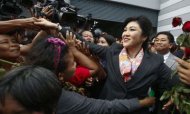
Thai Prime Minister Yingluck Shinawatra has been dismissed from office after the country's constitutional court ruled she was guilty of abusing her power.
According to the court ruled, by transferring a senior civil servant in 2011 to another position, Ms Yingluck was carrying out a "hidden agenda" that would benefit her politically powerful family.
Therefore, the court ruled, the act violated the constitution - a claim the PM has denied.
"The judges unanimously rule that Yingluck abused her prime minister status and interfered in transferring (Thawil Pliensri) for her own benefit," said court president Charoon Intachan in a televised ruling.
"Therefore her prime minister status has ended ... Yingluck can no longer stay in her position acting as caretaker prime minister."
Several cabinet ministers who endorsed the decision to transfer the security chief will also be stripped of their status.
The ruling means Ms Yingluck and nine members of her current caretaker Cabinet must step down from office.
Thailand's first female prime minister has been in power for more than two years but there has been considerable opposition to her position because of her brother, former PM Thaksin Shinawatra, who was ousted in a military coup in 2006.
Despite becoming skilled at fighting off political opponents, Ms Yingluck has spent recent months facing mass political demonstrations in the capital, Bangkok, with the Thai people calling for her to step down.
She came under strong criticism for her government's reaction to the flooding of 2011, which threatened to overwhelm Bangkok and ruin the economy.
The new PM of the caretaker government has been named as Niwattumrong Boonsongpaisan.

U.N. warns Nigeria's Boko Haram over selling schoolgirls as slaves


People take part in a protest demanding the release of abducted secondary school girls from the remote village of Chibok, in Lagos May 5, 2014. REUTERS/Akintunde Akinleye
People take part in a protest demanding the release of abducted secondary school girls from the remote village of Chibok, in Lagos 
GENEVA - The United Nations warned Islamist Boko Haram militants on Tuesday that there was no statute of limitations if they carried out their leader's threat to sell more than 200 Nigerian schoolgirls kidnapped last month.
Boko Haram leader Abubakar Shekau said in a video released on Monday that Allah (God) had told him to sell the girls taken by his fighters from a secondary school in the village of Chibok, in northeastern Borno state, on April 14.
"We warn the perpetrators that there is an absolute prohibition against slavery and sexual slavery in international law. These can under certain circumstances constitute crimes against humanity," U.N. human rights spokesman Rupert Colville told a news briefing in Geneva.
"That means anyone responsible can be arrested, charged, prosecuted, and jailed at any time in the future. So just because they think they are safe now, they won't necessarily be in two years, five years or 10 years time," he said.
He also urged Nigeria's federal and local authorities to work together to rescue the girls.
Local states have a lot of power and control over their territory, and the authorities in Borno are not of the same political party as the president, Colville said.
"So it is particularly important that there is close cooperation for the greater good, if you like, in this case, which is the release of these girls," he said.
Any buyer could also be held liable, Colville said, noting that enslaved girls are likely to be exposed to "continuous physical, psychological, economic and sexual violence" and that forced marriage can have a "devastating" impact on victims.
"The power differentials between girls and their 'spouses' is likely to undermine all autonomy, all freedom of will and expression of the girls. The situation they will be in will be tantamount to slavery, or slavery-like practices within the so-called marriage," he said.
U.N. High Commissioner for Human Rights Navi Pillay said after a visit to Nigeria in March that abuses by the security forces are boosting support for the group which has waged an increasingly bloody five-year-old insurgency in the north.
Pillay, a former U.N. war crimes judge, also said at the time that Boko Haram's actions were more and more monstruous.
She wrote to President Goodluck Jonathan on April 28 urging him to spare no effort to ensure the girls' safe return.
Any rescue attempt must be made in line with international human rights standards, Colville said, noting previous "allegations of excessive use of force by the Nigerian military in anti-Boko Haram operations".
Civilians should not be endangered, nor should there be summary executions or arbitrary detentions of suspects, he said.
Oh Lord our God, please help Nigeria and Nigerians! 

Tuesday, 6 May 2014

Japan meets most conditions for 'vital' EU trade talks - documents

Japan's Prime Minister Shinzo Abe makes a toast after speaking at the Guildhall in London May 1, 2014. REUTERS/Sang Tan/Pool
Japan's Prime Minister Shinzo Abe makes a toast after speaking at the Guildhall in London
A worker walks in a container area at a port in Tokyo April 21, 2014. REUTERS/Toru Hanai

BRUSSELS- The European Union will tell Japanese Prime Minister Shinzo Abe on Wednesday that Brussels is broadly satisfied with Japan's progress in negotiations towards an ambitious free-trade deal, likely allowing talks to continue, according to EU documents.
On the eve of Abe's visit to Brussels, one EU document shows that Japan has complied with, or is in the process of complying with, the majority of its commitments to help reach a trade pact that could encompass a third of global economic output.
Doubtful of Tokyo's willingness to bring down barriers to European exports, EU trade negotiators were told to pull the plug on talks, which began in April 2013, after a year if Japan did not show sufficient progress in areas from food to cars.
Abe, who arrives on Tuesday night for the EU summit the next day, has touted trade deals with Europe and the United States as crucial for Japan. But he failed to wrap up negotiations with Washington last month because of a pledge to protect Japan's politically powerful farmers.
After five rounds of talks with the European Union, the world's largest trading bloc, EU officials and diplomats say Japan has done enough for the negotiations with Europe to continue, although EU countries will likely decide on May 23.
"Japan has demonstrated it is as serious as any other of our trading partners," said one person close to the issue who declined to be identified. "We should allow talks to continue. If we push Japan too far, we will lose their confidence."
A draft of the EU-Japan summit's final statement seen by Reuters also reaffirms the "vital role that a fully comprehensive and ambitious free-trade agreement could play". Abe has said he hopes to agree the pact by the end of next year.
Potentially one of the world's biggest trade deals, an EU-Japan agreement could lift the economic output of both sides by almost 1 percent, according to the European Commission, at a time when both are struggling to generate growth.
Japan is the EU's seventh-largest export market buying some 70 billion euros (57.6 billion pounds) worth of European goods last year. For Japan, the EU ranks as its third-biggest market with shipments of 6.5 trillion yen (37.7 billion pounds) in 2012.
Japan already has low or no import tariffs on EU goods, with zero duty on cars, Scotch whisky or French cognac, for instance. Instead, the prize for Europe is in having Japan remove special regulations on everything from music to imported cars.
BARRIERS TO CARS
A Japan-EU deal would also fit into an emerging patchwork of sophisticated accords between the world's richest countries as they search for growth following the worst financial crisis in a generation and the failure of global free-trade talks.
The European Union is negotiating a separate trade pact with the United States that could generate $100 billion in additional economic output a year on both sides of the Atlantic.
European Commission President Jose Manuel Barroso and European Council President Herman Van Rompuy are expected to relay a message of support to Abe's trade agenda during their 90-minute summit and lunch on Wednesday, although French and Italian carmakers want to keep pressure on Japan.
In its review of Japan's progress in dropping trade barriers, the European Union is still demanding that Japan end preferential tax treatment for domestically produced small-engine cars. European carmakers such as Fiat and PSA Peugeot Citroen say they hamper their access to the Japanese market.
European cars are unable to benefit from Japanese tax breaks because they do not fit the criteria on size and power, an annoyance to Italy and France despite their specialisation in smaller cars.
EU carmakers say other barriers also hinder exports. Japan's use of its own safety and environmental standards rather than international ones adopted by the EU make approvals costly and time-consuming for Europeans.
Brussels is also warning that work to streamline Japan's process of authorising medical devices could take several years.

Curbing bad habits can stop 37 million premature deaths

Curbing smoking and drinking, salt intake, high blood pressure, high blood sugar and obesity can prevent more than 37 million premature deaths by 2025


Curbing smoking and drinking, salt intake, high blood pressure, high blood sugar and obesity can prevent more than 37 million premature deaths by 2025, according to an analysis published recently.
If globally-adopted targets for reducing these risk factors are met, the risk of dying prematurely from heart or lung disease, stroke, cancer or diabetes will fall by 22 percent in men and 19 percent for women in 2025, compared with 2010, a team of researchers wrote in The Lancet medical journal.
"Worldwide, this improvement is equivalent to delaying or preventing at least 16 million deaths in people aged 30 - 70 years and 21 million in those aged 70 years or older over 15 years," they said.
The targets are to reduce tobacco use by 30 percent, alcohol consumption by 10 percent, salt intake by 30 percent, high blood pressure by 25 percent, and to halt the rise in the prevalence of obesity and diabetes.
A more ambitious 50-percent reduction in smoking by 2025 would reduce the risk by more than 24 percent in men and by 20 percent in women, wrote the team.
They used national population data and epidemiological models for their calculations.
"Most of the benefits will be seen in low-income and middle-income countries where as many as 31 million deaths could be prevented," said co-author Majid Ezzati from Imperial College London.
Not reaching the targets would result in 38.8 million premature deaths in 2025 alone -- 10.5 million more than in 2010, the team said.
Premature mortality is defined for the purposes of the study as the probability of dying between the ages of 30 and 70.
The United Nations is targeting a 25-percent reduction in premature death from non-communicable diseases from 2010 to 2025.
This group of diseases is caused in large part by unhealthy lifestyles, including tobacco use, physical inactivity, the harmful use of alcohol and unhealthy diets.

India: Sexually 'Abused' Daughter Kills Father and Opens His Chest to Pull Out Pacemaker


India: Sexually 'Abused' Daughter Kills Father and Opens His Chest to Pull Out Pacemaker
India: Sexually 'Abused' Daughter Kills Father and Opens His Chest to Pull …

A 23-year-old woman in New Delhi has killed her father who had allegedly sexually abused her for the past three years.
The woman, Kulvinder Kaur, is said to have committed the crime with her boyfriend, Prince Sandhu, and a friend, Ashok Sharma, according to India Today. 
Since their arrest, the three accused admitted to beating the 56-year-old victim's head and face, with a cricket stump while he was asleep. They then strangulated him using their hands and a length of cable.
According to reports, Kaur then ripped open her father's chest with a piece of glass pulling out his pacemaker, to ensure he died.
With help from her accomplices, reports say, Kaur then stuffed her father's mutilated body into a car before dumping it near a drain in west Delhi.
Police recovered the body and the three were arrested within 72 hours.
"We arrested Prince and Sharma and recovered the blood stained cricket stump, cable, a knife, glass shards and the Innova," the region's additional commissioner of police, Ranvir Singh told The Times of India.
The police cracked down on the victim's daughter after tracing her call records that showed she was in constant touch with Prince and Sharma on the day of crime.
The woman confessed to her crime during sustained interrogation. She killed her father to stop him abusing her, she said, alleging that the man started abusing her sexually after her mother died three years ago. 
"She alleged her father made physical advances towards her and exploited her. If she objected, she was beaten up and threatened. He also did not allow her to meet her boyfriend. Finally, she made up her mind to get rid of him," an official said.